
The traditional belief that personal data is a corporate asset has inverted. In the current regulatory climate, data is a liability that scales with every byte collected. Organizations today struggle under a fragmented landscape where 20 U.S. states have enacted comprehensive privacy laws as of July 2026, and the administrative cost of maintaining large identity stores continues to escalate. You likely recognize the growing friction where the demand for rapid AI innovation meets the rigid oversight of the EU AI Act and the California Delete Act.
This article demonstrates how to reduce regulatory burden data risks by shifting toward a Zero Data Architecture. By adopting the Zero Data Protocol (ZDP), you can transition from a model of data extraction to one of functional interaction. We'll examine how the principles of Zero Collection and Zero Retention allow architects to lower overhead and accelerate time-to-market for AI-driven features without compromising systemic integrity.
Key Takeaways
- Shift from reactive administrative compliance to a structural architecture that treats data as a liability rather than a static asset.
- Define the Zero Data Protocol (ZDP) as an independent framework centered on Zero Collection, Zero Retention, and Zero Exploitation.
- Discover how to reduce regulatory burden data liabilities by limiting processing to immediate functional interactions and minimizing identity persistence.
- Address the specific technical requirements of the EU AI Act by implementing data-light principles within algorithmic systems.
- Establish a methodology for auditing data dependencies and integrating ZDP principles into existing Agile and DevOps lifecycles.
Understanding the Modern Regulatory Burden in Data Systems
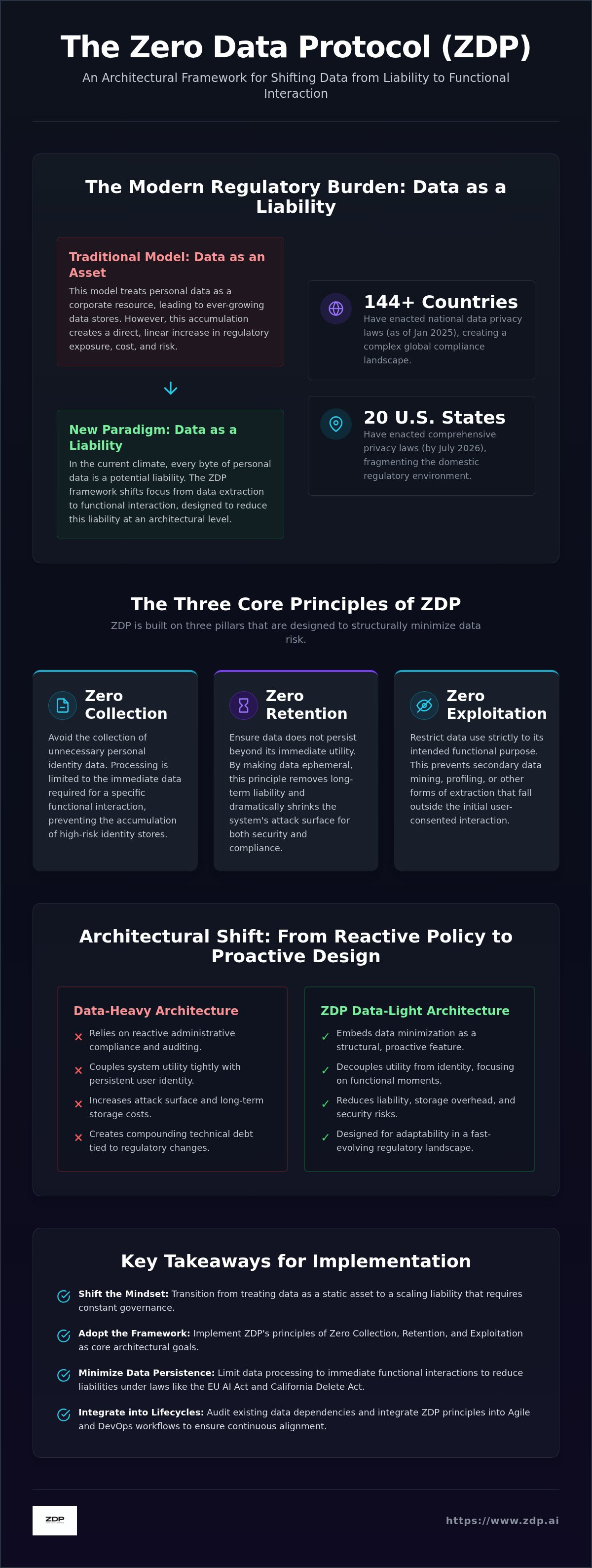
The regulatory burden is no longer a peripheral administrative concern; it is a foundational architectural cost. Instead of being defined by simple "red tape," this burden represents the total cost of compliance, reporting, and liability management. It is a structural tax on every byte of personal data an organization chooses to persist. As the number of comprehensive privacy laws grows globally, with 144 countries having enacted national data privacy laws as of January 2025, the complexity of managing these obligations has shifted from the legal department to the engineering team.
Modern regulations like the GDPR and the EU AI Act create a form of technical debt. When a system is built on a data-heavy architecture, every piece of personal identity data becomes a trigger for oversight. The correlation is linear: as data volume and identity persistence increase, regulatory exposure expands. To reduce regulatory burden data liabilities, architects must recognize that data is not a static asset but a dynamic risk that requires constant governance, auditing, and protection.
The Escalating Costs of Data Governance
The financial impact of continuous auditing and reporting is significant. Organizations often find that "identity management" acts as a hidden regulatory tax, consuming resources that could otherwise fuel innovation. Traditional strategies, such as creating data silos, often fail to provide effective risk mitigation because they don't address the underlying dependency on personal data. Instead of isolating high-risk data, the Zero Data Protocol (ZDP) suggests that we should minimize its collection entirely to maintain systemic integrity.
Regulatory Triggers: When Data Becomes a Liability
Liability is activated the moment specific data types enter a system. PII, biometric data, and behavioral patterns are primary triggers for intensive oversight. The persistence of this data extends the duration of liability, keeping the organization within the scope of regulations like the California Delete Act. A critical step in modern design is distinguishing between necessary functional data and high-risk identity data. By implementing data minimization, organizations can limit their processing to immediate functional interactions. This structural shift is designed to ensure that systems remain lean, efficient, and less susceptible to the escalating costs of the modern regulatory landscape.
Structural Strategies to Reduce Regulatory Overhead
Reducing the cost of compliance requires a move away from administrative oversight and toward architectural integrity. Instead of expanding legal departments to manage growing data stores, organizations can implement systems that fundamentally reduce regulatory burden data risks. This shift relies on a principled approach where data minimization is not a policy but a structural feature of the system design. By architecting for the absence of data, you change the nature of your regulatory obligations.
The Zero Data Protocol (ZDP) provides a consistent framework for this structural reduction. It is an independent architectural framework built on three core principles:
- Zero Collection: Avoiding unnecessary personal identity data and limiting processing to immediate functional interactions.
- Zero Retention: Ensuring that data does not persist beyond its immediate utility, thereby removing long-term liability.
- Zero Exploitation: Restricting the use of data strictly to its intended functional purpose, preventing secondary extraction or profiling.
Decoupling Utility from Identity
Digital services often operate on the assumption that utility requires identity. Instead of building persistent user profiles, systems can be designed to provide value during a "functional moment." For example, a financial analysis tool can process a transaction based on immediate inputs without ever linking that interaction to a permanent user ID. This strategy aligns with the focus of the Federal Trade Commission on Protecting Consumer Privacy and Security by minimizing the amount of sensitive information available for potential exposure or regulatory audit.
Minimizing the Retention Liability
Retention is the primary driver of regulatory risk. The longer data is stored, the higher the probability of a compliance failure or a security breach. Implementing Zero Retention ensures that data remains ephemeral. When information is processed and immediately discarded, the organization's "attack surface" shrinks significantly. This approach doesn't just protect against hackers; it protects against the compounding costs of data subject access requests and long-term storage audits. Architects seeking to reframe their approach can explore the Zero Data Protocol Framework to begin this transition toward a data-light environment.
Implementing Data-Light Architectures for AI and Cybersecurity
The EU AI Act introduces a significant layer of governance that often manifests as a technical tax on innovation. Instead of viewing these requirements as administrative hurdles to be bypassed with paperwork, architects can use structural data minimization to reduce regulatory burden data risks. By adopting the principles of the Zero Data Protocol (ZDP), organizations can build algorithmic systems that prioritize functional utility over identity extraction. This shift ensures that compliance isn't a reactive process but a fundamental outcome of the system's design.
Privacy-Safe AI Deployment
Algorithmic models don't inherently require personal identity to function effectively. Using ZDP principles prevents the accidental ingestion of sensitive PII into Large Language Models (LLMs) during training or inference. Developers can achieve this by limiting inputs to immediate functional data and ensuring that any necessary processing remains ephemeral. It's critical to remember that cryptographic hashes are not automatically anonymous; therefore, true minimization requires avoiding the collection of identifiers altogether. This approach balances model performance with the legal requirement for data minimization, ensuring that AI deployment remains trustworthy and structurally lean.
Cybersecurity as a Regulatory Shield
Cybersecurity is often treated as a layer of software added to a system to protect its contents. However, structural integrity provides a more robust defense than reactive tooling. When a system is designed with Zero Retention, the window of vulnerability for a data breach is minimized. While Zero Trust focuses on securing the access to data through continuous verification, ZDP eliminates the regulatory liability by ensuring the identity data was never collected or persisted in the first place. This reduction in data persistence naturally aligns with modern security recommendations for lowering organizational risk. Organizations can explore the Zero Data Protocol Framework to understand how to integrate these principles into their existing security stacks.
Transitioning to the Zero Data Protocol (ZDP) Framework
The transition to a data-light architecture is a deliberate shift in foundational logic. Instead of viewing compliance as a checklist of administrative tasks, architects must treat it as a structural dependency. This process begins with a structural audit to assess current data dependency. Organizations that successfully reduce regulatory burden data liabilities do so by identifying the exact points where identity data enters their ecosystems and questioning its functional necessity. Architecture is the lever; policy is the byproduct.
Integrating these shifts requires visibility. As systems become more complex, platforms like Sorank provide essential SEO and AI-visibility insights, ensuring that your data-light innovations remain discoverable and properly indexed in an AI-driven search environment. Visibility should not require the sacrifice of privacy; rather, it should be built on the integrity of the system's structural design.
Integrating ZDP into System Design
Transitioning to the Zero Data Protocol (ZDP) involves embedding its principles directly into the Agile and DevOps lifecycles. Teams should define "Zero Collection" thresholds for every new feature, ensuring they avoid unnecessary personal identity data and limit processing to immediate functional interactions. Instead of manual reviews, establish automated retention policies that default to deletion. It's also vital to train development teams on the ZDP vs. ZDR (Zero Data Retention) distinction, as understanding the difference between a broad architectural framework and specific retention tactics is necessary for long-term consistency.
Measuring the Impact of Data-Light Design
The success of a data-light transition is measured through clinical, quantifiable metrics. Organizations should track specific KPIs to evaluate their regulatory trajectory:
- Audit Hours: The total time spent by legal and engineering teams preparing for regulatory reviews.
- Compliance Costs: Direct expenditures on third-party auditing and administrative reporting.
- Data Volume: The total amount of persisted personal identity data currently held in storage.
Reducing these metrics provides a clear ROI for the "Zero Data" approach. By minimizing the persistence of high-risk data, you structurally lower the probability of a compliance failure. Architectural choices remain the most efficient way to lower regulatory costs and ensure systemic resilience. Explore the full Zero Data Protocol framework to begin reducing your structural burden and reclaiming your focus on innovation.
Architecting for Structural Resilience
The transition from administrative compliance to architectural integrity is not merely a technical preference; it's a strategic necessity. Organizations that continue to treat personal data as a static asset will find themselves perpetually reactive to an accelerating regulatory landscape. Instead of expanding the administrative overhead of reporting and auditing, architects can reduce regulatory burden data risks by adopting a framework that prioritizes the absence of data. By focusing on Zero Collection and Zero Retention, you shift the focus from managing liabilities to building systems with inherent structural integrity.
The Zero Data Protocol (ZDP) offers an independent, free architectural framework designed for global systems. It's built on the conviction that the safest data is the data you never collected. Implementing these principles ensures that your AI and cybersecurity initiatives are grounded in logic rather than reactive policy. We invite you to Download the Zero Data Protocol Framework to begin re-engineering your systems for a data-light future. You can lead the shift toward a standard where innovation and privacy are outcomes of the same disciplined design.
Frequently Asked Questions
How does the Zero Data Protocol (ZDP) help with GDPR compliance?
ZDP assists by reducing the volume of personal data processed, which naturally limits the scope of GDPR obligations. By implementing Zero Collection, organizations avoid unnecessary identity data and limit processing to immediate functional interactions. This structural reduction is designed to reduce regulatory burden data management costs by decreasing the number of records subject to Subject Access Requests (SARs) and impact assessments. It aligns technical architecture with the principle of data minimization.
Can an organization really operate with "Zero Collection" of data?
Zero Collection doesn't imply the absence of all data; instead, it refers to the avoidance of unnecessary personal identity data. Systems function by processing inputs required for immediate functional interactions without persisting those inputs as permanent user profiles. This approach decouples utility from identity, allowing a service to provide value based on current context rather than historical extraction. It requires a fundamental shift in how architects view the necessity of user persistence.
What is the difference between ZDP and Privacy by Design?
Privacy by Design is a high-level regulatory philosophy mandated by Article 25 of the GDPR; whereas, ZDP is a specific technical framework that provides the architectural path to achieve it. While Privacy by Design sets the goal of proactive protection, ZDP provides the structural principles, Zero Collection, Zero Retention, and Zero Exploitation, required to build systems that are data-light by default. It moves the conversation from legal theory to engineering execution.
Does ZDP provide a legal exemption from the EU AI Act?
ZDP does not provide automatic legal exemptions from the EU AI Act or any other regulation. It is designed to reduce regulatory burden data complexity by minimizing the high-risk inputs that trigger intensive governance requirements. By limiting the ingestion of personal data into AI models, organizations can lower their overall risk profile; however, they must still comply with all applicable transparency and oversight mandates relevant to their specific AI use cases and risk classifications.
How does Zero Retention affect cybersecurity insurance premiums?
Zero Retention is designed to reduce an organization's overall liability by ensuring that sensitive data does not persist beyond its immediate utility. While insurance premiums are determined by individual providers, insurers often view the reduction of stored personal data as a significant risk mitigation factor. A smaller data footprint limits the potential impact of a breach, which is a critical metric in modern risk assessment. Structural integrity remains the most effective defense against escalating premiums.
Is cryptographic hashing considered "Zero Data" or anonymous data?
Cryptographic hashes are not automatically considered anonymous data under regulations like the GDPR; they are typically classified as pseudonymous. ZDP emphasizes that true Zero Data architecture involves avoiding the collection of identifiers entirely rather than merely masking them. If a hash can be linked back to an individual through additional information, it remains personal data and carries associated regulatory liabilities. Anonymization requires the permanent removal of all identifying characteristics, which hashing alone does not achieve.

Article by
Lajos NAGY
Lajos NAGY is the founder and author behind Zero Data Protocol (ZDP), an independent architectural framework built around Zero Collection, Zero Retention, and Zero Exploitation. He writes about privacy by architecture, data-light systems, responsible AI, cybersecurity, and digital trust.
Important Notice
Zero Data Protocol (ZDP) is an independent educational and architectural framework. This article is provided for informational and educational purposes only. It does not constitute legal, regulatory, cybersecurity, compliance, financial, or other professional advice.
Laws, technical standards, security requirements, and regulatory obligations vary by jurisdiction, system, intended purpose, and use case. References to GDPR, the EU AI Act, cybersecurity frameworks, or other regulations should not be interpreted as guarantees of compliance or exemption.
Organizations should consult appropriately qualified legal, privacy, cybersecurity, engineering, or compliance professionals before making implementation decisions.


