
The most ethical data architecture is not the one that manages personal data most efficiently; it is the one that requires the least personal data to function. Organizations now face growing regulatory and technical pressure as major provisions of the EU AI Act become applicable from August 2026, while the EU Data Act—applicable since September 2025—reshapes access to and use of data generated by connected products and services. Traditional governance models that treat data as an asset to be accumulated have created significant technical debt, compliance costs, and structural liability.
Structural integrity requires moving beyond superficial privacy policies toward architectures that reduce data-related risk by design. By adopting a data-light philosophy, organizations can reduce unnecessary exposure, simplify parts of their compliance burden, and replace invasive extraction with systemic trust. This article presents a practical path from reactive data governance toward the Zero Data Protocol. It examines how to build systems defined as much by what they deliberately discard as by what they retain, creating architectures that remain resilient as laws, technologies, and security threats evolve.
Key Takeaways
- Shift from a model of reactive compliance to one of structural integrity, treating data ethics as a foundational design choice instead of a policy layer.
- Understand the Zero Data Protocol (ZDP) as a minimalist standard that replaces data extraction with functional, data-light alternatives.
- Learn how an ethical data architecture reduces regulatory burden by reducing data-related risk at its source instead of merely managing it after collection.
- Identify practical steps to audit system dependencies and liquidate the technical debt accumulated through invasive collection practices.
- Position your organization for long-term digital trust by adopting a "Zero-First" strategy that aligns with the structural requirements of the EU AI Act.
Table of Contents
The Shift from Defensive Privacy to Structural Ethical Data Architecture
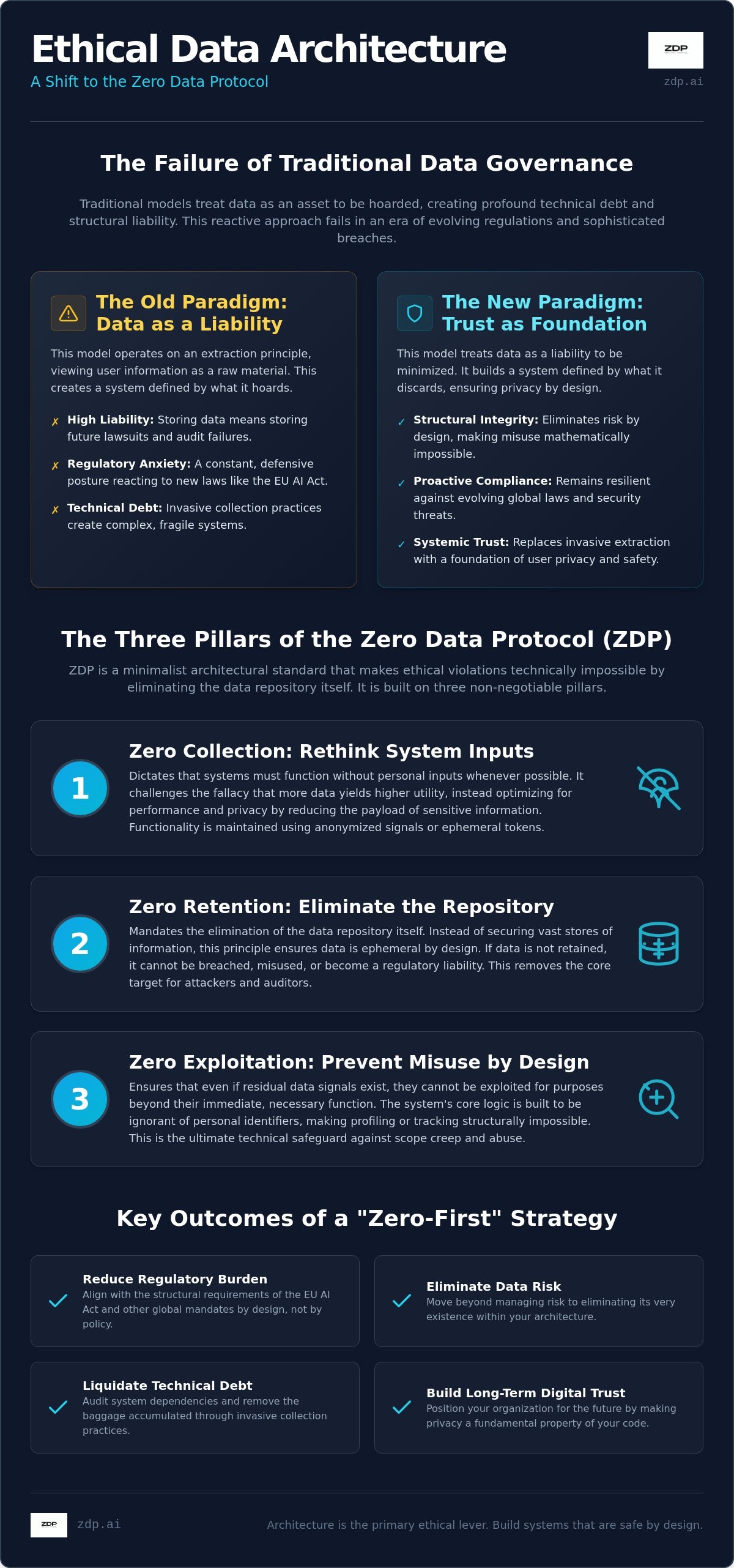
Traditional digital strategies operate on the extraction paradigm. They view user information as a raw material to be refined, stored, and exploited. This "Data as Oil" model is inherently adversarial. It creates a structural dependency on the very thing that introduces the most risk. Instead of treating data as an asset to be protected, we must treat it as a liability to be minimized. Under a "Trust as Foundation" model, ethical data architecture is recognized as the low-level logic of the system. It's the structural blueprint that defines the boundaries of interaction, ensuring that privacy isn't an afterthought but a fundamental property of the code.
Most organizations treat privacy as a defensive perimeter. They build invasive systems and then layer governance policies on top to satisfy legal requirements. This approach is fundamentally flawed. A Data architecture that prioritizes structural integrity doesn't rely on the efficacy of a policy. It relies on structural constraints that substantially reduce the possibility of personal-data misuse by preventing unnecessary information from entering or persisting within the system. This shift requires a total re-evaluation of the data lifecycle. It's not enough to encrypt what we take; we must question the act of taking itself. Structural integrity offers a more sustainable method for reducing digital risk in an era of increasing surveillance and sophisticated breaches.
The Failure of the Governance-Only Approach
Managing personal data creates ongoing regulatory and operational pressure. Organizations must respond to the phased application of the EU AI Act, the EU Data Act, and other jurisdictional requirements without relying on patchwork fixes. Unnecessary retention increases the cost of security controls, documentation, audits, incident response, and legal review. Ethical architecture reduces those burdens by removing avoidable data dependencies from the system’s core logic.
Architecture as the Primary Ethical Lever
We must move from asking how we use data to why we collect it at all. The architect serves as a steward of systemic integrity. Every structural choice sets an ethical limit. If a system's logic depends on personal identifiers, that system is inherently fragile and prone to exploitation. By adopting an ethical data architecture, the designer builds a robust framework that remains functional regardless of the regulatory climate. The architect's role is not only to secure the vault, but also to question whether it needs to contain personal data at all. This "Zero-First" approach dictates that functionality should never be traded for privacy, but rather built upon its presence.
The Three Pillars of the Zero Data Protocol (ZDP)
The Zero Data Protocol (ZDP) represents a fundamental departure from traditional data management. Rather than assuming that large repositories of personal information must exist and then be secured, ZDP proposes minimizing or eliminating those repositories wherever functionality allows. It is a minimalist architectural framework operating at the level of system logic. While governance frameworks provide principles for responsible acquisition and management, ZDP defines technical constraints intended to make unnecessary collection, retention, and secondary exploitation far less likely. Its three pillars are Zero Collection, Zero Retention, and Zero Exploitation.
Zero Collection: Rethinking System Inputs
Default system design often assumes that more data yields higher utility. This is a fallacy of extraction. Zero Collection does not mean that a system receives no functional input. It means that the system does not accumulate personal identity data beyond what is strictly necessary for the immediate interaction. Zero Collection dictates that systems must function without personal inputs whenever possible. By using non-identifying signals, local processing, or short-lived tokens, architects can preserve functionality without necessarily creating a persistent identity record. In some systems, a smaller sensitive-data footprint can reduce processing, governance, and security overhead. However, encryption, access controls, logging, and other safeguards may still remain necessary depending on the architecture and use case. This isn't just an ethical choice. It's a performance optimization. Reducing the payload of sensitive data streamlines processing and removes the latency inherent in complex encryption and access control layers. Organizations can begin implementing these principles through the Zero Data Protocol Framework to re-engineer their input logic from the ground up.
Zero Retention and Exploitation
Zero Exploitation complements this principle by restricting data to the specific purpose for which it was temporarily processed. Even when information must exist briefly, it should not be reused for unrelated profiling, advertising, model training, or other secondary purposes without a valid and explicit basis. This keeps the system focused on delivering immediate value to the user rather than extracting additional value from their identity or behavior.
Long-term retention is a major source of technical debt and exposure. Zero Retention shifts the focus from indefinite storage to time-bounded, purpose-limited processing. Data required for an immediate function should be deleted or irreversibly de-identified once that purpose is complete, subject to legitimate legal or operational requirements. This reduces the formation of long-lived data stores that may become targets for breaches or lawful access requests.
Evaluating Ethical Frameworks: Governance vs. Structural Minimization
Traditional frameworks for data ethics focus on administrative control. They emphasize transparency, consent, and ownership as a means of managing the inherent risks of data collection. While foundational models, such as the 5 Principles of Data Ethics, provide a necessary moral compass, they remain high-level policy layers. They don't address the underlying structural flaws of the extraction model. Instead of asking how to manage data ethically, we must ask if the data needs to exist at all. An ethical data architecture prioritizes structural elimination over policy-based governance. It replaces the fragile promise of "good management" with the hard reality of "no data."
This distinction is increasingly important as organizations prepare for the phased application of the EU AI Act. Some obligations already apply, while major provisions become applicable from August 2026 and certain high-risk-system requirements follow later timelines. Reactive management can require extensive documentation, monitoring, and governance. Structural data minimization can reduce privacy-related exposure and simplify certain compliance duties by limiting the personal information processed. However, an AI system’s high-risk classification still depends on its intended purpose, regulatory category, and context of use; eliminating personal identifiers does not automatically remove that classification.
Structural Constraints vs. Policy-Based Governance
Policies remain vulnerable to human error, shifting corporate priorities, and inconsistent enforcement. Architectural constraints are generally more durable than policy alone and harder to bypass unintentionally. By applying Zero Data Protocol principles, organizations can reduce both the technical attack surface and the regulatory exposure associated with unnecessary personal-data stores. A structured Data Dependency Audit can then reveal where system functionality remains coupled to personal identifiers, persistent storage, or secondary data use.
The Business Value of Data-Light Architectures
Data-light systems can be more agile because they carry less overhead associated with sensitive-data storage, encryption-key management, access reviews, and breach response. They still require robust security controls, but a smaller data footprint can make those controls easier to govern and defend. Legacy architectures are weighed down by the technical debt of invasive collection; data-light systems move with purposeful efficiency. This structural choice builds radical trust with users. Modern consumers are increasingly privacy-literate and skeptical of vague governance promises. They don't want to be told their data is safe. They want to know you don't have it. Reducing the cost of compliance through design isn't just an ethical win. It's a competitive advantage.
There's a persistent misconception that "Zero Data" equals "Zero Insight." This is false. Insight is a product of processing, not necessarily of retention. You don't need to store a user's identity to understand their intent. By focusing on ephemeral signals and real-time processing, you can deliver highly personalized experiences without the structural risk of identity extraction. The goal isn't to know less; it's to function without the burden of knowing who.
Implementing a Data-Light Architectural Strategy
Implementing an ethical data architecture isn't an administrative task; it's an engineering discipline. It begins with a "Zero-First" approach to new system design. Instead of asking what data the system can collect, the architect defines the minimum functional signal required for the system to operate. This proactive stance establishes a baseline of structural safety before the first line of code is written. It treats data as a volatile substance that should only be handled when absolutely necessary for a specific, transient function.
To transition existing legacy systems, you must follow a methodical liquidation of data dependencies. This process moves beyond simple auditing and into the active decoupling of functionality from identity. By following these steps, organizations can systematically reduce their risk profile:
-
Identify every point where personal identifiers are used as primary keys or session tokens.
-
Map functional outcomes to the data inputs that trigger them.
-
Replace persistent storage with ephemeral, real-time processing pipelines.
-
Eliminate data fields that serve "potential future use" rather than immediate functional requirements.
Integrating these principles into the software development lifecycle ensures that structural integrity is reviewed during every iteration. Teams can use a Data Dependency Audit to examine how deeply system functionality relies on identity, persistent storage, telemetry, and secondary data use. This process helps developers identify and decouple unnecessary dependencies before they reach production, making the Zero Data Protocol a measurable architectural discipline rather than a vague aspiration.
Privacy-Safe AI Deployment
AI development presents a unique challenge to structural integrity. Traditional models often require massive datasets for training, creating a permanent trail of sensitive user information. An ethical AI architecture breaks this dependency. It utilizes synthetic data for training and local, on-device processing for inference. This ensures that the model learns from patterns rather than identities. By reducing the volume of personal inputs, you also mitigate the risk of algorithmic bias. Removing direct demographic identifiers may reduce certain forms of explicit discrimination. However, proxy variables, biased datasets, and unequal deployment contexts can still produce discriminatory outcomes. A privacy-safe AI architecture must therefore combine data minimization with rigorous bias testing, model evaluation, and human oversight.
The Developer’s Role in Ethical Construction
The engineer is the primary steward of systemic trust. This requires a shift from "feature-first" to "integrity-first" engineering. Developers must advocate for ZDP by framing it as a reduction in technical debt and operational risk. Practical patterns such as local-first processing, short-lived tokens, selective disclosure, and purpose-limited identifiers should become standard. Cryptographic hashes of personal identifiers should not automatically be treated as anonymous data, because they may remain linkable. Advocacy within a commercially-driven organization succeeds when you demonstrate that structural safety is the most efficient path to long-term scalability. A system that doesn't hoard data is a system that doesn't break under the weight of its own liabilities.
Future-Proofing Systems with the Zero Data Standard
The Zero Data Protocol proposes a further stage in the evolution of ethical data architecture. Historically, systems moved from no protection to encryption, and then to the administrative layer of privacy by design. Each step was a reaction to the risks of the extraction model. An ethical data architecture offers a proactive alternative to the traditional extraction model. It replaces the fragile, human-led promise of "good management" with the hard, technical reality of "no data." By adopting this standard, you aren't just adjusting a policy; you're defining a new architectural paradigm that prioritizes systemic health over data hoarding.
ZDP moves the conversation from how data should be protected to whether it needs to be collected or retained at all. This structural approach offers a durable way to strengthen resilience amid rapid technological change and growing regulatory scrutiny. Architects who apply the framework as a professional discipline can help establish a more rigorous engineering culture. A system that holds less sensitive data presents a smaller and more defensible target.
Beyond Compliance: The Era of Digital Trust
The market is shifting from legal compliance alone toward demonstrable structural integrity. Organizations must navigate the phased application of the EU AI Act, cross-border access rules, and national data-protection requirements. ZDP cannot remove every jurisdictional obligation, but reducing persistent personal-data stores can simplify data-sovereignty decisions and lower cross-border exposure. In 2026, the architect’s duty is not only to secure data flows, but also to question whether those flows are necessary.
Joining the Zero Data Movement
Systemic change requires a collective commitment to rigorous standards. The ZDP framework provides the technical vocabulary and structural rules necessary to sustain this transition. By integrating these principles, you contribute to a digital ecosystem defined by utility rather than extraction. You can begin with a Data Dependency Audit to map existing collection points, retention mechanisms, identity dependencies, and secondary uses. This isn't a temporary trend; it's the establishment of a foundational protocol for safer AI and cybersecurity. It's time to move beyond the superficiality of privacy policies and embrace a framework that reduces data-related risk by design Adopt the Zero Data Protocol for your next project and lead the move toward structural integrity.
The Architecture of Durable Integrity
The transition from reactive governance to structural safety is an engineering necessity. Instead of layering complex policies over invasive extraction models, you must build systems that function through the deliberate absence of data. An ethical data architecture replaces the fragility of human oversight with the permanence of technical constraints. By anchoring your design in the Zero Collection Principle, the Zero Retention Principle, and the Zero Exploitation Principle, you insulate your organization from the compounding liabilities of data hoarding and regulatory volatility.
Systemic trust is earned through the clinical removal of dependencies. As digital environments become increasingly autonomous, the architect's duty is to ensure that privacy is a foundational property of the code rather than a secondary administrative layer. You have the opportunity to define a new standard for cybersecurity and AI development. Secure your system's future with the Zero Data Protocol and begin constructing frameworks that respect human autonomy by design. The path to a resilient digital future starts with the first structural choice you make today.
Frequently Asked Questions
What is ethical data architecture?
Ethical data architecture is a structural blueprint that prioritizes systemic integrity alongside policy-based governance. It redesigns system logic so that personal data is not collected or retained unless it is functionally necessary. Rather than merely managing the risk of misuse after collection, this approach reduces that risk at its source by limiting unnecessary data dependencies.
How does Zero Data Protocol differ from Privacy by Design?
Privacy by Design is a broad methodology that embeds privacy throughout the lifecycle of a product or system, including data minimization, security, transparency, and privacy-protective defaults. The Zero Data Protocol is a more specific architectural framework that pushes this logic further by asking whether personal data needs to be collected or retained at all. ZDP therefore complements Privacy by Design by translating its principles into stricter constraints around collection, retention, and secondary exploitation.
Can a business still gain insights with a zero-retention policy?
Utility is a product of processing, not necessarily of retention. You can derive profound insights from ephemeral signals and real-time data streams without committing that information to a persistent database. This allows for personalized user experiences and operational efficiency while liquidating the technical debt and liability associated with long-term data storage.
Which data privacy principle is violated in a 'collect-all' scenario?
A "collect-all" strategy primarily violates the principle of data minimization. It also contradicts the requirement for purpose limitation, as it gathers information for unspecified future exploitation. This extraction model creates a permanent state of structural fragility, as every unnecessary data point serves as a potential vector for breach or regulatory failure.
How does ethical architecture reduce regulatory burden?
By removing unnecessary personal identifiers from the system’s core logic, an ethical data architecture can reduce privacy-related exposure, documentation requirements, security controls, and data-governance overhead. It does not automatically exempt an organization from the EU AI Act or other regulations, because obligations still depend on the system’s purpose and legal classification. It does, however, create a smaller and more defensible compliance surface.
Is Zero Data Architecture compatible with AI and Machine Learning?
Zero Data Architecture can support privacy-preserving AI when applied carefully. Synthetic data, federated or local processing, short-lived context, and strict purpose limitation may reduce exposure to personal information, but none of these techniques automatically guarantees anonymity, fairness, or model safety. Their suitability depends on the use case, training method, legal basis, deployment context, and surrounding technical controls.
What are the first steps to transitioning to a data-light architecture?
The transition begins with a structured audit of existing data dependencies. Identify every point where system functionality is unnecessarily coupled to personal identity, persistent storage, telemetry, or secondary data use. Classify each input as functionally essential, temporarily necessary, or removable. This gives architects a measurable roadmap for moving from reactive patching to proactive, data-light design.
How does the ZDP framework improve cybersecurity?
The ZDP framework improves cybersecurity by reducing the amount of valuable personal data available within a system. Traditional security builds defenses around data repositories; ZDP also questions whether those repositories need to exist. When a system minimizes collection and applies time-bounded retention, fewer stored assets are available to an attacker, reducing both the likelihood and potential impact of a data breach.

Article by
Lajos NAGY
Lajos NAGY is the founder and author behind Zero Data Protocol (ZDP), an independent architectural framework built around Zero Collection, Zero Retention, and Zero Exploitation. He writes about privacy by architecture, data-light systems, responsible AI, cybersecurity, and digital trust.
Important Notice
Zero Data Protocol (ZDP) is an independent educational and architectural framework. This article is provided for informational and educational purposes only. It does not constitute legal, regulatory, cybersecurity, compliance, financial, or other professional advice.
Laws, technical standards, security requirements, and regulatory obligations vary by jurisdiction, system, intended purpose, and use case. References to GDPR, the EU AI Act, cybersecurity frameworks, or other regulations should not be interpreted as guarantees of compliance or exemption.
Organizations should consult appropriately qualified legal, privacy, cybersecurity, engineering, or compliance professionals before making implementation decisions.
