
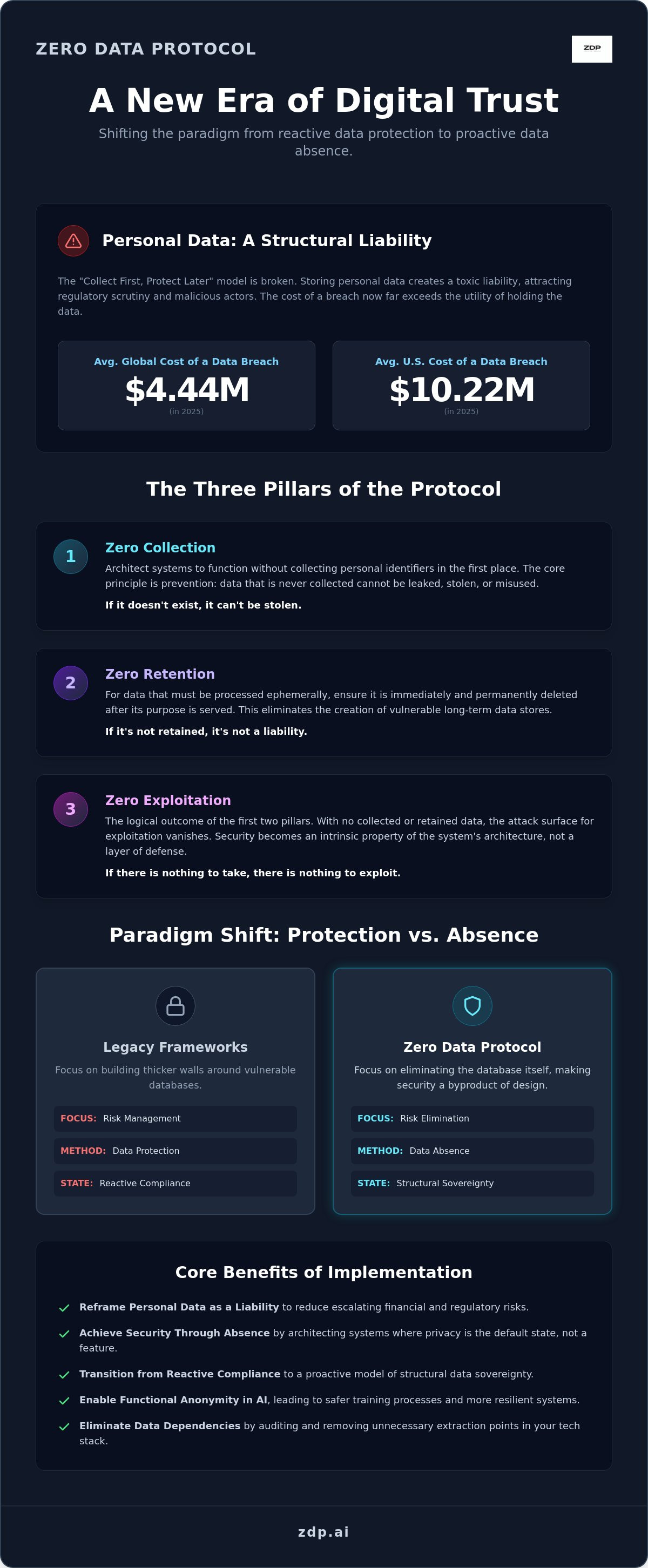
Personal data is not a strategic asset; it's a structural liability that increases in toxicity the longer it's held. When the average cost of a data breach reached $4.44 million in 2025, the industry received a definitive signal that the traditional model of data extraction is fundamentally broken. You likely feel the weight of this technical debt as you navigate the rigid requirements of the EU AI Act and expanding state privacy mandates. The Zero Data Protocol offers a necessary departure from this legacy logic. Instead of building thicker walls around vulnerable databases, this framework prioritizes the security of data absence.
This article provides the blueprint for building digital trust through structural integrity. You'll learn how to eliminate the liability of personal information while maintaining the functional utility of your systems. We'll analyze the three core pillars of the protocol, Zero Collection, Zero Retention, and Zero Exploitation, to establish a disciplined framework for developing the next generation of data-light products.
Key Takeaways
- Reframe personal data as a structural liability to reduce the escalating financial and regulatory risks of modern digital systems.
- Understand the three architectural pillars of the zero data protocol to build systems where security is a byproduct of data absence.
- Transition from reactive compliance models to proactive structural sovereignty by prioritizing the elimination of data dependencies.
- Identify how to implement functional anonymity in AI models, ensuring safer training processes and more resilient cybersecurity.
- Learn to utilize a data dependency audit to pinpoint and remove unnecessary extraction points within your technical stack.
Redefining Digital Trust: Why Personal Data Has Become a Structural Liability
Personal data has transitioned from a strategic asset into a toxic structural liability. For decades, the prevailing technical doctrine encouraged the indiscriminate extraction of user information, operating under the assumption that more data inevitably led to more value. This "Collect First, Protect Later" model has reached its logical breaking point. Instead of fueling innovation, massive data stores now function as gravity wells for risk, attracting regulatory scrutiny and malicious actors with equal intensity. Systems built on the premise of data dependency are inherently fragile; they require constant, expensive maintenance to defend against an ever-expanding threat landscape.
The hidden costs of this dependency are now quantifiable. Beyond the immediate financial impact of a breach, organizations face significant regulatory friction from mandates like the GDPR, CCPA, and the emerging EU AI Act. This friction manifests as technical debt, where engineering resources are diverted from product development to the perpetual management of consent logs and access controls. True digital trust cannot be manufactured through legal disclosures or marketing promises. It must be engineered into the system itself. By adopting the zero data protocol, architects can achieve structural sovereignty, creating products where the absence of data is not a limitation, but a foundational security feature.
The Failure of Traditional Data Defense
Traditional defense mechanisms are no longer sufficient to offset the risks of data retention. In 2025, the average cost of a data breach reached $4.44 million globally, while incidents in the United States averaged a staggering $10.22 million. These figures suggest that the cost of storage has surpassed the utility of the information held. The industry currently suffers from "Consent Fatigue," a state where complex legal disclosures fail to address the underlying structural flaws of a system. Furthermore, the "Protect Forever" mindset is becoming obsolete in a post-quantum environment. If a system stores sensitive identifiers today, those identifiers remain vulnerable to future decryption, creating a permanent liability that no current firewall can mitigate.
A Paradigm Shift: From Protection to Absence
The zero data protocol represents a fundamental departure from legacy privacy frameworks. While traditional security focuses on building thicker walls around vulnerable databases, this protocol focuses on the elimination of the database itself. The logic is clinical and absolute: if data does not exist within your environment, it cannot be stolen, leaked, or subpoenaed.
- Securing Data: Relies on the perfection of encryption and human vigilance.
- Eliminating Data: Relies on the structural absence of the target.
Transitioning to a data-light architecture creates a significantly smaller, more defensible attack surface. By removing the need for personal identifiers at the protocol level, organizations move beyond the cycle of reactive patching. They instead embrace a system design where privacy is the default state, rather than a bolted-on compliance requirement.
The Three Pillars of the Zero Data Protocol: Collection, Retention, and Exploitation
The zero data protocol operates through an integrated triad of architectural constraints. These pillars are not optional guidelines; they are the foundational requirements for any system seeking to eliminate data liability. While the NIST Privacy Framework establishes a valuable baseline for managing privacy risk through data minimization, ZDP moves beyond risk management into risk elimination. It replaces the burden of protection with the security of absence. By aligning system architecture with these three principles, organizations create an environment where trust is a structural certainty rather than a policy promise.
This framework functions as a cohesive ecosystem. Each pillar supports the others, creating a cumulative effect that radically reduces a system's attack surface. Instead of treating privacy as a series of disconnected compliance tasks, the protocol treats it as a singular engineering problem. If a system does not collect data, it has nothing to retain. If it retains nothing, there is no resource to exploit. This logical progression ensures that systemic integrity remains intact even as external threats evolve.
Zero Collection: Rethinking System Inputs
System design must begin with a rigorous distinction between functional necessity and extractive habit. Most legacy architectures gather personal identifiers by default, creating a surplus of "extracted" data that serves no immediate operational purpose. Zero Collection shifts the focus toward functional-based interactions. In this model, a system requests only the ephemeral inputs required to complete a specific task. Once the task is finished, the input is discarded. Zero Collection is the proactive refusal of unnecessary digital debris. By refusing to ingest sensitive identifiers at the source, architects prevent the creation of the very databases that malicious actors target. The goal is to provide full utility while maintaining total anonymity of the user's identity.
Zero Retention and Exploitation: Maintaining Integrity
Retention is the bridge between a functional interaction and a long-term liability. The zero data protocol mandates an "Ephemeral by Default" standard for application state. This means that any data processed during a session must be purged immediately upon completion. There is no caching, no archiving, and no secondary storage of user-specific information. This structural barrier naturally leads to Zero Exploitation. When a system lacks a historical record of user behavior, it becomes impossible to engage in algorithmic targeting or behavioral profiling. The system's utility remains high because it focuses on providing direct value to the user, rather than extracting value from the user's presence. Architects can explore the Zero Data Protocol Framework to begin auditing their own system dependencies and identifying where extraction can be replaced with functional anonymity.
ZDP vs. Legacy Privacy Frameworks: Moving Beyond Compliance to Data Absence
Legacy frameworks like GDPR and CCPA function as regulatory floors. They establish the minimum legal requirements for data stewardship but do not address the underlying structural flaws of data dependency. The zero data protocol represents the architectural ceiling. While compliance frameworks focus on the "how" of data protection, ZDP focuses on the "why" of data existence. This shift in perspective is rooted in the fundamental realization that data is not an asset, it's a liability; a liability that grows more dangerous as systems scale. Instead of managing risk through policy, ZDP eliminates risk through geometry.
In a modern security stack, ZDP complements Zero Trust Architecture by removing the target that Zero Trust seeks to protect. Zero Trust operates on the principle of "never trust, always verify" regarding access to resources. ZDP goes a step further by ensuring the resource itself, specifically personal data, is absent from the environment. This creates a more scalable strategy than complex encryption alone. Encryption is a temporal shield that may fail against future compute power; data absence is a permanent structural state that requires no defense.
ZDP vs. GDPR: Compliance vs. Architecture
Traditional compliance is a reactive process that triggers whenever "Personal Data" enters a system. By contrast, the zero data protocol automates compliance by removing the trigger entirely. If a system does not ingest or retain identifiers, it falls outside the scope of many burdensome regulatory requirements. This reduction in regulatory friction is a significant operational advantage. Auditors prefer systems with no data to audit because it removes the possibility of human error or policy failure. This is the evolution of "Privacy by Design" from a vague policy guideline into a rigorous technical protocol.
ZDP vs. Zero-Knowledge and Zero-Party Data
There's a common misconception that ZDP is synonymous with Zero-Knowledge Proofs (ZKP) or Zero-Party Data. While ZKP provides a brilliant cryptographic method for proving a statement without revealing the underlying data, it's often complex to implement and computationally expensive. ZDP is a simpler, low-level architectural choice to avoid the data altogether. Similarly, the concept of "Zero-Party Data" is often a fallacy; asking a user for their preferences is still a collection event that creates a database of liabilities.
- Zero Data Protocol: Focuses on the structural absence of data at the protocol level.
- Zero-Knowledge Proofs: Uses advanced cryptography to verify data without exposure.
- Zero Trust: Focuses on rigorous verification of every user and device attempting to access a network.
Instead of building systems that prove things about data, architects should build systems that function without it. This reduces the complexity of the security stack and ensures that the system utility remains independent of the user's personal identity.
Engineering Structural Sovereignty: A Roadmap for Data-Light System Design
The transition from a data-heavy legacy to a data-light future requires more than a shift in policy; it demands a rigorous technical roadmap. Structural sovereignty is not a passive state of compliance. It is an engineered outcome. Instead of managing the symptoms of data toxicity, architects must dismantle the extraction points that create it. The zero data protocol provides the necessary framework for this transition, moving the focus from defensive storage to purposeful absence. By following a disciplined roadmap, organizations can reclaim their technical integrity and eliminate the structural risks that define the current digital landscape.
The Data Dependency Audit
The first stage of implementation is the Data Dependency Audit. This process begins with the Axiomatic Question: Does the system break if this specific data point is missing? If the answer is no, the data is a structural liability and must be eliminated. Architects must map every digital flow, scrutinizing often-overlooked areas such as logs, telemetry, and session cookies. This audit categorizes data into two distinct groups:
- Functional Essential: The minimum ephemeral inputs required to execute a specific logic or transaction.
- Structural Liability: Any identifiable information that persists beyond the immediate functional need, creating a target for extraction or breach.
Mapping these flows reveals the hidden dependencies that tether a system to high-risk data stores. Once these liabilities are identified, the engineering team can begin the process of structural decoupling.
Building the Data-Light Stack
Engineering for functional anonymity requires a shift toward local-first processing and stateless architectures. Instead of pulling user data into a centralized cloud environment for processing, architects should push the logic to the edge. Local-first design ensures that sensitive information remains on the user's device, where the user maintains physical and digital control. This approach effectively removes the organization from the data custody chain, fulfilling the core promise of the zero data protocol.
Stateless architectures further reinforce this integrity by ensuring that web and mobile applications do not retain residues of user interactions. Each request is treated as an independent event, with no persistent session data stored on the server. To maintain this standard across complex digital ecosystems, developers can integrate tools like Sorank to monitor and preserve structural integrity. Organizations ready to move beyond the limitations of legacy privacy models should utilize the Zero Data Protocol Framework to guide their architectural transformation.
Implementing the Zero Data Protocol: The Future of Responsible AI and Cybersecurity
The integration of artificial intelligence has introduced a new dimension of structural risk that legacy security models cannot contain. Instead of viewing AI as a tool for deeper data extraction, principled architects must view it as a potential vector for systemic leakage. The zero data protocol addresses the "Black Box" risk by ensuring that sensitive identifiers never enter the inference pipeline. When a model lacks access to personal data at the protocol level, the risk of accidental memorization or unauthorized reconstruction is structurally eliminated. This is the only viable path to securing the AI supply chain in an era of automated exploitation.
Digital trust is not a sentiment to be managed; it's a technical outcome to be engineered. By adopting a data-light framework, organizations move beyond the cycle of reactive patching and toward a state of structural immunity. The protocol serves as a catalyst for this shift, providing a rigorous standard for systems that prioritize functional utility over data possession. As automated threats become more sophisticated, the most resilient defense is not a stronger wall, but a smaller target.
ZDP for AI and Machine Learning
Large Language Models (LLMs) present a unique challenge for data stewardship due to the risk of data leakage during both training and inference. Standard retention policies often fail to account for the persistence of data within model weights or context windows. Applying the zero data protocol to AI development requires a disciplined approach to prompt history and session state. Instead of archiving user interactions, systems must adopt Zero Retention principles that purge context windows immediately after a task is completed. Building "Privacy-First AI" means establishing structural boundaries that prevent the model from ever ingesting sensitive inputs. This methodology ensures that the utility of the AI remains high while the liability remains at zero.
The Path to a Data-Light Internet
The transition to a data-light internet is a clinical necessity. In a 2026 market defined by the full application of the EU AI Act's general provisions, the ability to operate without personal data is the ultimate competitive advantage. Organizations that continue to hoard data will find themselves burdened by escalating compliance costs and structural vulnerabilities. Conversely, those that embrace the ZDP standard will enjoy a streamlined operational profile and a defensible security posture. The next generation of digital products will not be defined by how much they know about the user, but by how much value they provide without knowing the user at all. To begin this transition, architects and engineers should Explore the Zero Data Protocol Framework and join the community defining these new structural standards.
Architecting the Future of Digital Integrity
The persistence of personal data in modern systems represents a fundamental architectural flaw that no amount of encryption can fully resolve. By embracing the zero data protocol, organizations shift their focus from the defensive posture of data protection to the strategic advantage of data absence. This framework provides the necessary discipline to mitigate structural risk in AI deployment and reduces breach liability by eliminating toxic assets at the source. Instead of managing the symptoms of data dependency, architects can now engineer systems where trust is a byproduct of structural integrity.
Achieving structural sovereignty requires a commitment to the three pillars of Zero Collection, Zero Retention, and Zero Exploitation. This transition replaces the burden of compliance with the clarity of systemic logic. It's time to move beyond the limitations of legacy privacy models and build products that prioritize functional utility over user extraction. Start building with the Zero Data Protocol framework to redefine the foundation of your digital ecosystem. The path to a resilient, data-light future is a matter of deliberate design.
Frequently Asked Questions
What is the main difference between Zero Data Protocol and GDPR?
The main difference lies in the nature of the requirement. GDPR is a legal mandate that defines the boundaries of data stewardship; the zero data protocol is a technical architecture that eliminates the need for stewardship by removing the data itself. While compliance frameworks provide a regulatory floor for handling information, ZDP provides an architectural ceiling by ensuring that sensitive identifiers never enter the system environment.
Does implementing ZDP mean I can't personalize my user experience?
Implementing ZDP does not preclude personalization. Instead of relying on historical behavioral profiling, systems can utilize ephemeral inputs provided by the user in the moment or leverage local-first processing on the user's device. This approach allows for a highly tailored experience where the logic is applied to the context rather than the identity. Value is delivered through functional relevance without the structural risk of persistent user tracking.
Is Zero Data Protocol the same as Zero Trust security?
ZDP and Zero Trust are distinct but complementary strategies. Zero Trust focuses on the rigorous verification of every entity attempting to access a network resource. In contrast, the zero data protocol focuses on the elimination of the most toxic resource: personal data. By removing the data that attackers seek, ZDP reduces the stakes of any potential unauthorized access, providing a foundational layer of security that Zero Trust then defends.
How can a system function if it doesn't collect any user data?
Systems function by prioritizing functional necessity over data extraction. A system can execute complex logic by processing inputs within a stateless session or at the edge, returning the result to the user without archiving the source information. This shift moves the focus from "who is the user" to "what does the user need to accomplish." Utility is maintained through purposeful interaction rather than the accumulation of digital residues.
Is ZDP a software product I need to buy or a framework?
ZDP is a free architectural framework rather than a commercial software product. It provides the principled guidelines and structural logic required to design data-light systems. While tools like Sorank can be used to maintain structural integrity within this framework, the protocol itself is an open standard intended to reframe how digital products are built. It is a resource for architects committed to long-term systemic change.
How does the Zero Data Protocol reduce the cost of a data breach?
The protocol reduces breach costs by structurally removing the liability. Since the financial impact of a breach is largely dictated by the volume and sensitivity of the data exposed, a system with no stored identifiers has no inherent liability to lose. By aligning with ZDP principles, organizations ensure that a technical compromise does not escalate into a catastrophic regulatory or financial event. Data absence is the ultimate insurance policy.
Can ZDP be applied to existing legacy systems, or only new ones?
ZDP is applicable to both new builds and legacy environments. While it's simplest to implement during the initial design phase, existing systems can be refactored through a systematic Data Dependency Audit. This involves identifying non-essential extraction points and decoupling them from the core functional logic. Transitioning a legacy stack to a data-light model is a methodical process of reducing structural debt one dependency at a time.
Is ZDP useful for companies building AI and LLM applications?
ZDP is essential for responsible AI development. It prevents sensitive user information from being ingested into the training or inference pipelines of Large Language Models. By enforcing Zero Retention within context windows, developers can build AI applications that provide sophisticated insights without the risk of memorizing or leaking personal identifiers. This methodology ensures that AI utility remains high while the privacy of the underlying data remains absolute.

Article by
Lajos NAGY
Lajos NAGY is the founder and author behind Zero Data Protocol (ZDP), an independent architectural framework built around Zero Collection, Zero Retention, and Zero Exploitation. He writes about privacy by architecture, data-light systems, responsible AI, cybersecurity, and digital trust.
Important Notice
Zero Data Protocol (ZDP) is an independent educational and architectural framework. This article is provided for informational and educational purposes only. It does not constitute legal, regulatory, cybersecurity, compliance, financial, or other professional advice.
Laws, technical standards, security requirements, and regulatory obligations vary by jurisdiction, system, intended purpose, and use case. References to GDPR, the EU AI Act, cybersecurity frameworks, or other regulations should not be interpreted as guarantees of compliance or exemption.
Organizations should consult appropriately qualified legal, privacy, cybersecurity, engineering, or compliance professionals before making implementation decisions.
