
If every byte of stored user data represents a structural liability rather than a digital asset, the current industry obsession with data accumulation is a fundamental architectural flaw. In a landscape where U.S. data breaches now cost an average of $10.22 million, the traditional data lake has become a primary source of systemic risk. You likely recognize that the weight of data is no longer sustainable, especially as the 2026 CCPA amendments impose stricter transparency and consent requirements. Transitioning to a data-light application architecture allows you to replace the symptoms of data hoarding with structural integrity.
This article provides the blueprint for engineering these systems. You'll learn how to construct resilient, high-performance applications by replacing data accumulation with structural minimization. We'll outline a framework for building data-independent systems that lower security risk profiles and provide foundational architectural clarity.
Key Takeaways
- Reframe data from a strategic asset into a structural liability to mitigate the escalating costs and risks of the traditional data lake paradigm.
- Adopt the Zero Data Protocol (ZDP) pillars of Zero Collection, Zero Retention, and Zero Exploitation to establish a foundational standard for system integrity.
- Design a data-light application architecture using edge computing and stateless microservices to remove the structural need for persistent user data storage.
- Transition from passive data hoarding to active verification logic through a methodical audit and refactoring of existing codebase dependencies.
- Reduce regulatory exposure and security risks by replacing traditional data accumulation with a framework of structural minimization.
Table of Contents
-
The Weight of Data: Why Traditional Architectures are Failing
-
Defining Data-Light Application Architecture: Principles of Minimization
-
Engineering the Shift: Implementation Strategies for Developers
The Weight of Data: Why Traditional Architectures are Failing
For decades, software engineering has operated under the assumption that data is a strategic asset to be hoarded. This paradigm birthed the data lake, a structural artifact designed for indiscriminate ingestion and delayed processing. Instead of serving as a reservoir of value, these architectures have evolved into reservoirs of risk. The transition from asset to liability occurs the moment a system stores information it does not require for its immediate functional state. When an application prioritizes accumulation over structural minimization, it creates a permanent security vacuum that no amount of encryption can fully remediate.
The hidden costs of the "schema-on-read" philosophy are now becoming visible. While unconstrained collection was once marketed as a way to future-proof business intelligence, it has instead institutionalized technical debt. Every byte of persistent user data represents a point of failure, a regulatory trigger, and a potential financial drain. System integrity is not a product of better firewalls or more complex security layers; it is a direct function of data independence. Building a data-light application architecture requires a fundamental shift in perspective. It demands that we view every stored record as a potential breach vector rather than a future opportunity.
The Accumulation Trap vs. Structural Integrity
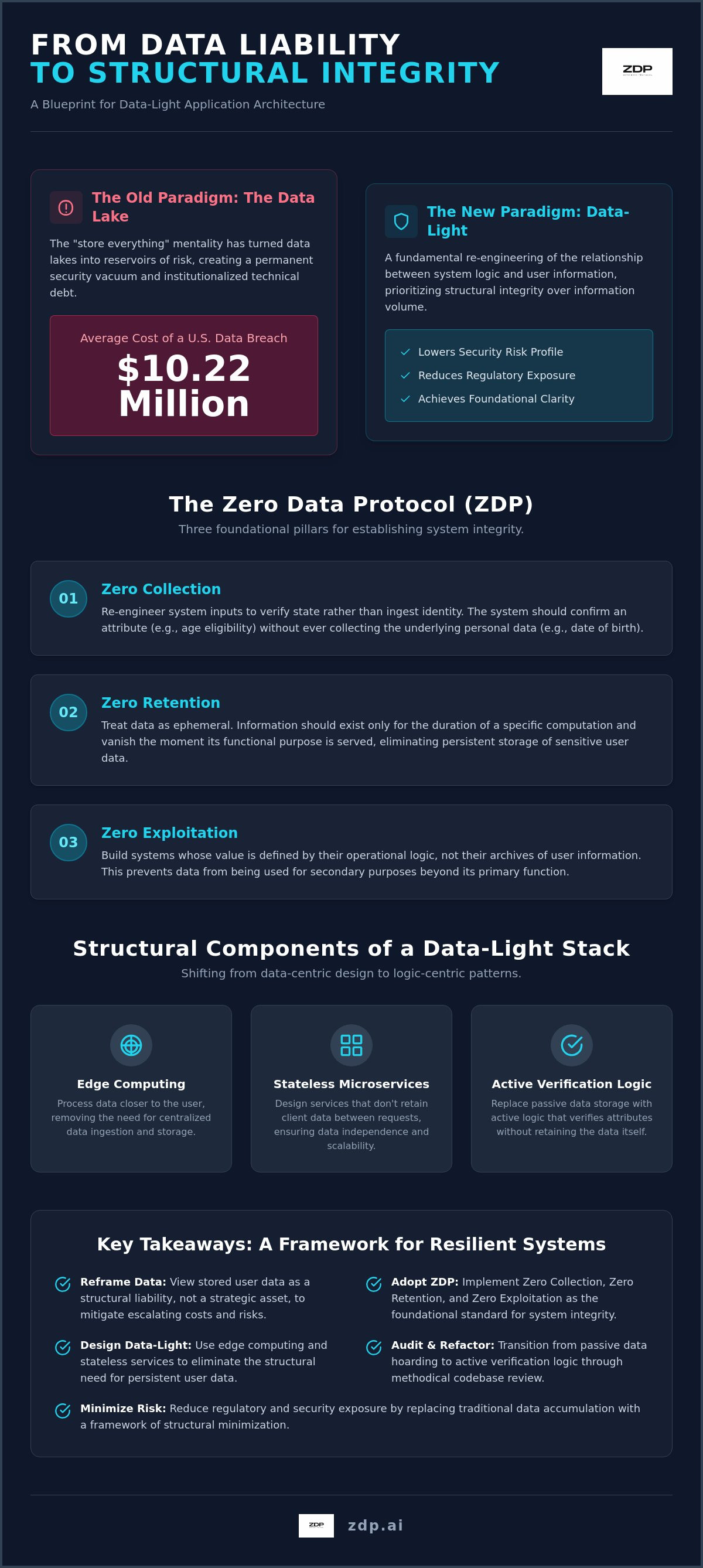
The "store everything" mentality is the antithesis of principled engineering. It replaces intentional design with a chaotic hope that volume will eventually yield insight. There is a direct, measurable correlation between data volume and breach impact. According to 2025 research, the average cost of a data breach in the United States has reached $10.22 million, a figure driven largely by the sheer scale of compromised records. Instead of providing flexibility, indiscriminate hoarding creates a rigid infrastructure that is difficult to secure and expensive to maintain. True structural integrity is found in the discipline of extraction, where a system's value is defined by how little it knows about its users, not how much it retains.
Regulatory Burden and the Cost of Persistence
Data persistence triggers expensive, never-ending compliance cycles that drain engineering resources. As of the January 1, 2026, CCPA amendments, businesses face even more stringent requirements regarding the explicit listing of shared data categories and the mandatory detection of Global Privacy Control signals. These regulations turn persistent storage into a constant operational tax. Managing user deletion requests and "right to be forgotten" protocols in a massive data lake is an architectural nightmare that often requires manual intervention and complex audit trails. Persistence-driven risk is the inherent vulnerability created by the unnecessary duration and volume of stored personal information, which mandates perpetual compliance monitoring and increases the financial impact of structural failures. By minimizing persistence, an organization can bypass these cycles entirely, reclaiming the focus for core product innovation.
Defining Data-Light Application Architecture: Principles of Minimization
A data-light application architecture is not merely an optimization of existing storage methods; it is a fundamental re-engineering of the relationship between system logic and user information. While traditional models treat data as the fuel for functionality, a data-light framework treats it as a dependency to be minimized. This approach prioritizes structural integrity over information volume. It ensures that applications remain functional even as their access to personal data is restricted by shifting the focus from "what do we know?" to "what can we verify?".
The core of this philosophy is codified in the Zero Data Protocol Framework, which establishes three foundational pillars: Zero Collection, Zero Retention, and Zero Exploitation. By shifting from data-centric designs to logic-centric patterns, engineers can build systems that operate on ephemeral processing. In this model, data exists only for the duration of a specific computation. It vanishes the moment its functional purpose is served. Instead of building a system around a central database, developers build around a central set of rules. This transition ensures that the architecture is defined by its operations rather than its archives.
Zero Collection: Rethinking System Inputs
Engineering for Zero Collection means designing inputs that verify state rather than ingesting identity. Instead of capturing a user's full date of birth to confirm age eligibility, a principled system utilizes Zero-Knowledge Proofs (ZKP). This allows the system to verify the attribute without ever receiving the underlying value. This shift moves processing to the edge. Local-first methodologies keep sensitive information within the user's control, utilizing the client device as the primary processing engine. By verifying conditions at the source, the central architecture remains clean. It stays unburdened by the liability of ingested records that would otherwise trigger compliance costs.
Zero Retention: The End of Data Hoarding
Zero Retention is the structural antidote to the "honeypot" effect. When a system is designed with immediate data expiration by default, it ceases to be an attractive target for attackers. Instead of persistent databases that store history indefinitely, data-light systems utilize stateless streams that process information in transit. This architectural choice ensures that even a successful breach yields no historical archive. By replacing persistent storage calls with verification logic, developers eliminate the accumulation of toxic assets. It's a move toward a state where the system's security is guaranteed by its own emptiness rather than the thickness of its digital walls. Retention is no longer the default; it's a structural failure to be engineered out of the stack.
Structural Components of a Data-Light Stack
A data-light application architecture requires a fundamental reconfiguration of the traditional technology stack. Instead of a centralized core that pulls data inward, this model utilizes distributed components that push logic outward. This architectural inversion ensures that sensitive information remains at the periphery, never entering the central transit layers where it would become a liability. By integrating edge computing, stateless microservices, and decentralized identifiers, engineers can build systems that are functionally robust yet structurally vacant of personal data.
Edge computing serves as the primary filter, processing information at its point of origin. This prevents the unnecessary transit of raw data to central servers. Complementing this is the use of stateless microservices, which eliminate the dependency on persistent session data. When a service doesn't need to "remember" a user's previous state to function, the requirement for a persistent database vanishes. Identity is managed through Decentralized Identifiers (DIDs), allowing for verification without a central registry. Finally, encrypted compute environments enable the execution of logic on data without the system ever "seeing" the underlying values, maintaining systemic integrity through mathematical certainty rather than administrative trust.
The Ephemeral Data Layer
The transition to a data-light state involves replacing traditional SQL or NoSQL persistence with volatile memory caches. In high-concurrency applications, patterns for transient data handling ensure that information exists only for the duration of a specific transaction. Once the functional output is generated, the input data is purged from memory. This shift ensures that the system's "memory" is as short-lived as the task it performs. Ephemeral by design is the new security standard because a system that retains nothing offers no surface area for exploitation.
Decentralized Verification Architectures
Providing personalized experiences doesn't require the storage of static user profiles. Instead, decentralized verification architectures allow systems to request specific proofs from a user's local device. Sorank plays a critical role here, serving as a tool for maintaining system integrity by verifying these structural proofs without ingesting the data itself. This allows for the integration of third-party verification services without risking data leakage. By utilizing these decentralized patterns, an application can deliver highly tailored services while remaining structurally data-independent. It's a move from centralized authority to distributed verification, where trust is built into the architecture rather than stored in a table.
Engineering the Shift: Implementation Strategies for Developers
Transitioning to a data-light application architecture is a methodical process of structural extraction. It begins with a rigorous audit of the existing codebase to identify non-essential data dependencies. Instead of accepting every database call as a functional necessity, engineers must scrutinize the purpose of every stored record. The refactoring stage involves replacing persistent storage calls with verification logic, ensuring the system remains operational without the liability of a permanent record. To ensure the integrity of this shift, developers can utilize the Zero Data Protocol Framework to measure architectural lightness against established structural pillars. Deployment occurs in phased sequences, shifting logic to the periphery to ensure service continuity while reducing the central data footprint.
The transition is not merely a technical update; it is a redirection of systemic intent. By validating the architecture against the ZDP pillars, organizations can quantify their reduction in regulatory exposure. This process replaces the "collect and protect" cycle with a "verify and vanish" workflow. It's a move toward a state where security is a baseline characteristic of the code rather than an external service. When the architecture itself is light, the operational burden of compliance and security monitoring is naturally diminished.
The "Verify, Don’t Collect" Pattern
The "Verify, Don’t Collect" pattern represents a shift from ingestion to validation. Instead of storing a user's unique identifier in a persistent table, a system can utilize cryptographic hashes as functional placeholders. This allows for state management without exposing the underlying identity. By utilizing these hashes, API payload sizes are naturally reduced, leading to lower latency and decreased storage costs. Structural minimization is a performance optimization that removes the friction of heavy data transit, replacing bulk with mathematical precision.
Data-Light AI: Safer Model Deployment
Data-light principles are critical for the safe deployment of artificial intelligence, particularly as "shadow AI" becomes a primary driver of breach costs. Traditional AI implementations often rely on centralizing user prompts, which creates significant security vulnerabilities. A data-light approach prioritizes inference at the edge, keeping sensitive prompts within the local context. Differential privacy functions as a structural component, ensuring that model training doesn't leak individual data points. By building AI agents that operate on local-only context, developers can harness advanced intelligence without the catastrophic risk of a centralized data breach.
The Zero Data Protocol: A Blueprint for Resilient Systems
The Zero Data Protocol (ZDP) represents the definitive standard for engineering resilient systems. It is a structural manifesto for privacy-first software design. Instead of relying on external security layers to protect accumulated data, ZDP embeds protection into the system's core logic. This approach ensures that systemic integrity is a product of the architecture itself rather than a collection of reactive "privacy tools." By adopting a data-light application architecture, organizations can eliminate the fundamental vulnerability of the data lake paradigm. This structural shift moves the industry toward a state where security is not an administrative burden but an inherent property of the code.
Adopting the Zero Data Protocol framework is the essential next step for any organization seeking to future-proof its infrastructure. It replaces the fragility of data hoarding with the stability of structural minimization. The long-term competitive advantage of data-light organizations is found in their agility. They aren't burdened by the escalating storage costs or the legal liabilities that define traditional, data-heavy enterprises. Instead of managing a growing archive of risks, they manage a streamlined engine of functionality. This architectural clarity allows for faster iteration and a more robust security posture that persists regardless of shifting threat landscapes.
Beyond Compliance: Building Digital Trust
In 2026, digital trust is the ultimate marketing differentiator. Users are increasingly aware of the risks associated with data persistence, especially as the January 1, 2026, CCPA updates mandate clearer opt-out controls and symmetric consent. A data-light approach allows a brand to speak with the authority of a partner that respects user boundaries. It reduces the "Privacy Tax" on innovation by eliminating the need for expensive compliance audits and complex data-handling protocols. To start your transition, you should review the ZDP principles and assess how your current stack aligns with the pillars of Zero Collection and Zero Retention. When you stop treating data as a commodity, you start treating trust as a structural component.
Establishing the New Standard for Structural Integrity
The transition from a data-centric to a logic-centric paradigm is no longer a matter of preference; it's a structural necessity for the modern engineer. By reframing persistent data as a liability rather than an asset, you reclaim the capacity for principled innovation. Adopting a data-light application architecture ensures that your system remains resilient against escalating regulatory costs and security vectors. Instead of building thicker walls around a growing data lake, you build a framework that requires no walls at all.
This shift represents an authority-driven framework for system architects who prioritize systemic clarity over information volume. It provides a structural reduction of regulatory risk and establishes a foundational standard for a post-privacy world. The path forward is defined by extraction rather than accumulation. To begin this transformation, you can Adopt the Zero Data Protocol Framework and lead the shift toward an era of principled, high-performance systems. The future belongs to the architectures that know exactly what to forget.
Frequently Asked Questions
What is the difference between data-light architecture and data minimization?
Data minimization is a policy of restraint; data-light application architecture is the structural implementation of that restraint. While minimization asks an organization to collect only what's necessary, a data-light framework ensures the system is engineered to function without possessing the data at all. It moves the burden from administrative policy to architectural logic, replacing the management of data with its structural exclusion.
Can an application really function with "Zero Collection"?
Yes, by shifting the processing engine to the user's local device. Instead of ingesting raw inputs for server-side computation, the system verifies the results of local-first processing. This ensures the central architecture receives only the functional proof required to execute logic, leaving the private variables under the user's control. Functionality is maintained through verification rather than ingestion.
Does data-light architecture increase latency due to edge processing?
Latency is typically reduced because the system avoids the heavy transit of massive data payloads to a central core. By processing at the edge and utilizing stateless streams, you eliminate the bottlenecks inherent in centralized database writes and complex ETL pipelines. Efficiency is a natural byproduct of structural minimization, as the network is no longer burdened by the weight of toxic assets.
How does the Zero Data Protocol handle necessary user authentication?
The Zero Data Protocol utilizes Decentralized Identifiers (DIDs) to verify identity without the need for a central registry. Authentication becomes a cryptographic proof of access rights rather than a database lookup of a username and password. This ensures the system confirms a user's authority to act without ever holding a persistent, vulnerable record of their personal credentials.
Is data-light architecture compatible with existing SQL databases?
Compatibility is maintained through a methodical process of structural refactoring. Existing SQL databases can be adapted to store cryptographic hashes or functional tokens instead of raw personal information. This allows organizations to leverage legacy infrastructure while moving toward a state that minimizes the liability of the storage layer. Over time, the database evolves from a primary store into an ephemeral cache.
How do I explain the benefits of a data-light approach to stakeholders?
Frame the discussion around risk extraction and the reduction of operational liabilities. Explain that every byte of stored personal data represents a potential financial drain, especially as 2026 CCPA amendments increase the cost of compliance. A data-light approach lowers insurance premiums, minimizes the impact of potential breaches, and builds a brand identity centered on digital trust and structural integrity.
Can I use ZDP principles for legacy system refactoring?
Legacy systems are ideal candidates for refactoring using the ZDP framework. You can introduce stateless microservices at the ingress point to verify and hash data before it reaches the legacy core. This creates a protective layer that gradually hollowing out the data lake, reducing the volume of sensitive information without requiring a full system replacement.
What is the role of ZKPs in a data-light stack?
Zero-Knowledge Proofs (ZKPs) provide the mathematical foundation for verification without exposure. They allow a system to confirm that a statement is true, such as verifying a user's age or residency, without requiring the underlying raw data. ZKPs are the essential mechanism that allows a data-light application architecture to maintain high functionality while remaining structurally vacant of personal information.

Article by
Lajos NAGY
Lajos NAGY is the founder and author behind Zero Data Protocol (ZDP), an independent architectural framework built around Zero Collection, Zero Retention, and Zero Exploitation. He writes about privacy by architecture, data-light systems, responsible AI, cybersecurity, and digital trust.
Important Notice
Zero Data Protocol (ZDP) is an independent educational and architectural framework. This article is provided for informational and educational purposes only. It does not constitute legal, regulatory, cybersecurity, compliance, financial, or other professional advice.
Laws, technical standards, security requirements, and regulatory obligations vary by jurisdiction, system, intended purpose, and use case. References to GDPR, the EU AI Act, cybersecurity frameworks, or other regulations should not be interpreted as guarantees of compliance or exemption.
Organizations should consult appropriately qualified legal, privacy, cybersecurity, engineering, or compliance professionals before making implementation decisions.

